UV degradation, and other factors. — by Tim Elverston
A customer asked us:
On Apr 4, 2013, at 4:38 AM,
magnus@*****.*** wrote:
Hi! This is not so much a repair inquiry, but more like
a question spurred out of curiosity. I'm a paraglider,
and in our community it's a well known fact that the
canopy is very sensitive to all sorts of things, such as
unnecessary exposure to sunlight, crease, water
(especially salty water), and dragging it along the
ground.
There are a LOT of theories on how to best store and
pack your glider to keep it in good condition. Some of
the newer gliders force you to pack the glider
accordion-style, which some people say is bad due to the
extra crease. Hell, some people even try to convince me
to use a different packing method when storing my glider
for the winter, compared to when its being packed for
hiking or to be used within the next few days.
I am not a kite surfer, but I sometimes fly in the same
area. It always amaze me how the kites apparently have
no problem dealing with salty water, and (from the looks
of it) a lot more wear and tear. I also hardly ever see
the kite surfers store their kites in UV-bags in-between
flights.
We paragliders always do that, to minimize UV-exposure
when the glider is on the ground.
My question to you guys is how does the fabric in a
paraglider differ from a kite, and why is so much more
sensitive to these things? Would it be possible to
create a paraglider with the same material, without
losing to much of its performance etc? I'm not entirely
sure you are the correct people to ask this question,
but with your unique view on both kites and paragliders,
i thought I'd ask anyway!
Thanks in advance, Best regards Magnus
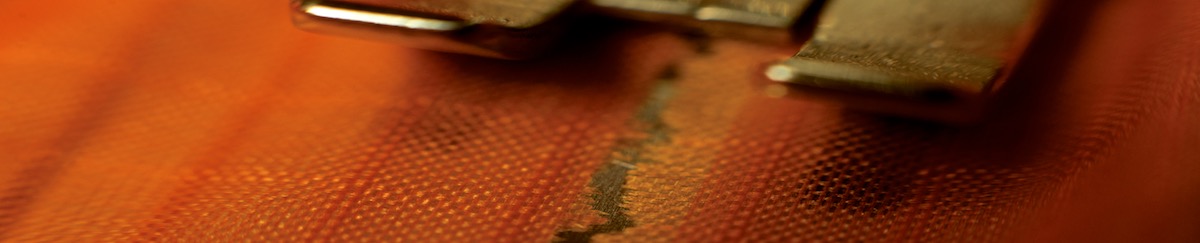
Here we see the weakening effects of ultraviolet exposure on
polyester fabric.
It's interesting to note that the cloth above doesn't
look as though it's about to fail. When we touched it,
however, we knew it was "in its twilight,"
shall we say.
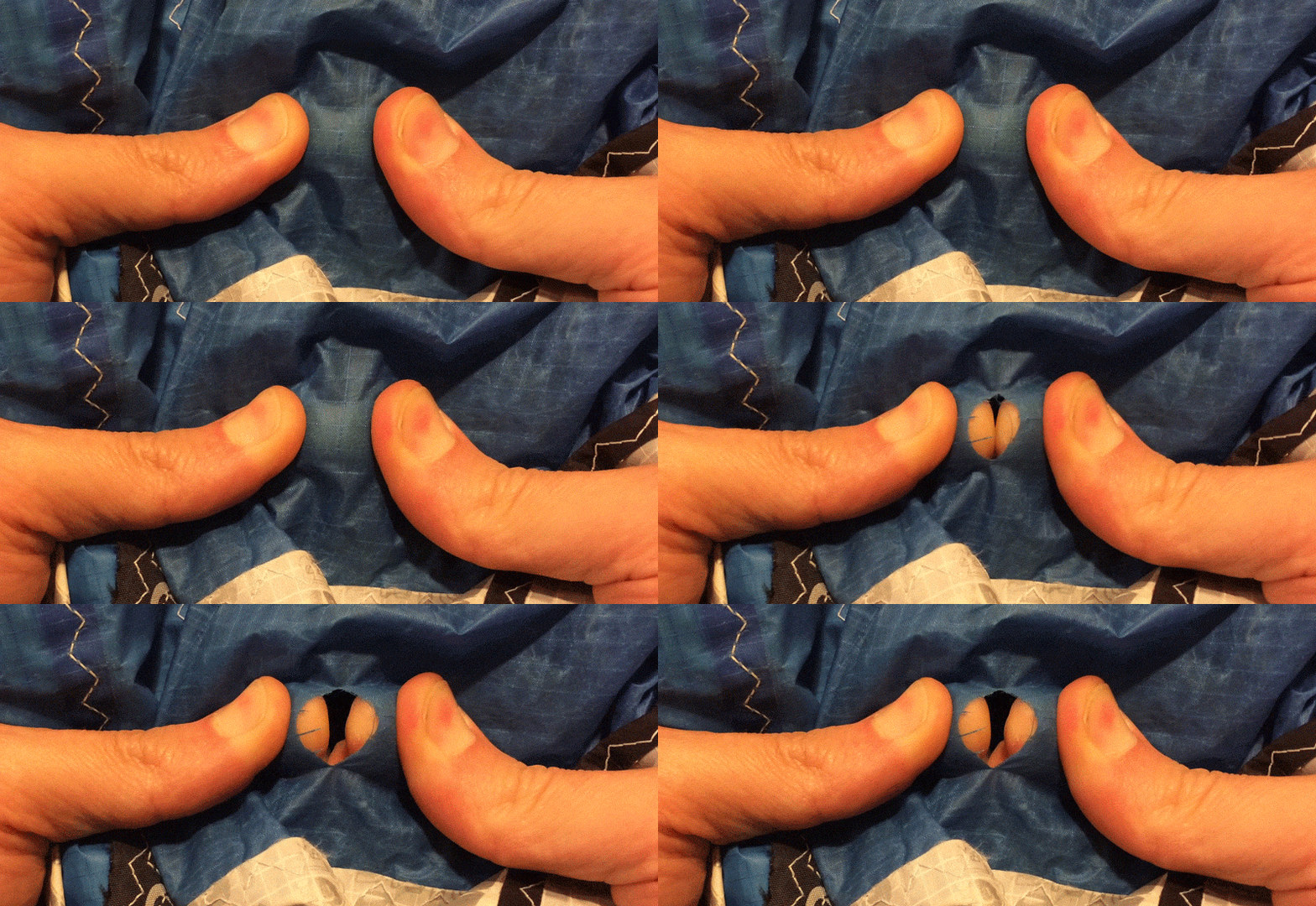
This ripped with about as much force as is required to
rip a paper towel. New cloth of this type would resist
all but the strongest hands if, as here, there was no
pre-existing rip.
Article below is my response:
On Apr 4, 2013, at 7:11 PM,
Tim at WindFire Designs wrote:
Hi there Magnus,
This is actually a great question, and one that we have
given quite a bit of thought to over the years. We have
repaired literally thousands of wings now, from everyone
using soft wings in all kinds of sports. Also, I am
personally a materials freak, and a collector of
forensics knowledge via all the different types of
damage we see.
I have formed a rather large data set about everything
you mention here.
I agree that paragliders fall under special scrutiny,
but I don't agree that it's totally warranted in every
area, and every case. Like any industry with
enthusiasts, there are a lot of rumors and practices
that may or may not have any basis in real data. That
said, here is what we see as demonstrable fact.
Factors that break down the synthetic cloth
and its coatings in kites and paragliders
The factors that kill paraglider cloth are not much of a
mystery, and they are exactly the same as those which
kill the fibers used in kitesurfing kites. They are UV,
and direct abrasion. Creasing repetitively in the same
place isn't great either, but it's mostly a secondary
factor that actually relates back to UV in a way that
I'll explain later. Direct abrasion, where focused point
pressure is dragged across a set of fibers will be hard
to avoid suffering damage from as a result.
Free-floating sand, however, that is not trapped between
the cloth and another surface which is able to apply
pressure against it, will not cause any appreciable
problem for the fibers. So as long as the sand is just a
small amount, and is free to fly around and eventually
fall out, i wouldn't freak out over it too much. We see
a certain level of sand in almost every wing we work on,
and it doesn't seem to us to be the huge enemy everyone
imagines it is.
Stress damage and the life of fabric in a soft wing
Another obvious factor in damage, is simply where the
breaking load on a fiber exceeds its rating. This is
obvious, and doesn't really merit a lot of discussion.
Don't pull on the fibers with greater force than they
are proven via testing to rebound from. Additionally,
don't cut a fiber with something sharp.
Kite and paraglider fabrics
UV light exposure vs. water
There is no question that sun exposure is to blame for
most of the degradation occurring over the life of any
fabric wing. Actually I don't agree that water, or even
salt water, plays a huge role in the breakdown of high
performance fibers. Take Dacron for instance. It's
actually just a brand name for very pure polyester.
Polyesters, woven thinly, are what the canopies of kites
and paragliders are made from. This same fiber, albeit
woven differently, is regularly used inside the body as
a way to fix hernias.
As one must now ask, how can water, even water with
electrolytes, be a huge factor on these fibers if they
are used in the body? The answer is that water is not a
real risk at all. These fibers are incredibly noble, and
are actually used in their sheet and film forms to make
normal plastic bottles that store all kinds of crazy
chemicals, like solvents, and acids, and all kinds of
things in very toxic industries.
Above we see the same fabric both shielded and exposed
to UV. The area inside the seam, which we were taking
apart as a necessary step for a repair, shows the
original color of the cloth.
The fabric was not simply dirty. This yellowing was
completely uniform wherever the fabric was exposed to
the sun.
Storing kite and paraglider fabrics wet
There are a few secondary risks to water, such as
mildew, dye transfer, and the extreme forces associated
with dragging a submerged wing out of a body of water.
But wet fabric in and of itself should pose no real
threat. So what about salt? Well, it's true, that salts
can crystalize after the water dries, and these micro
crystals can then start to break down the coatings on
the fabric. However, usually it's UV that beats all of
these factors no matter how much care is taken.
Wet synthetic fabrics will change dimension while wet,
but this is true also with changes in humidity. People
regularly fly soft wings when there is measurable
humidity in the air. Is that a factor? Well it certainly
interacts with the cloth, we can see this as dew forms
on wings late in the day. The water is there whether
it's forming droplets or not. Personally I wouldn't give
it a second thought.
Coatings on paraglider cloth and kite cloth
In paragliders, these fibers are coated both before and
after the weaving process. In their coatings they use
compounds just like you smear on your skin for sun
protection, such as aluminum dioxides, and titanium
dioxides. The UV gradually starts to work on these
compounds, breaking them apart each time the energy
collides with the substances. The reason that repetitive
creasing is bad, is because it will start to form cracks
in the coatings on the fibers.
These coatings then loose their ability to protect the
fibers from the sun in those cracks, and leaves the sun
to hit the fibers directly.
Again, there is some secondary risk to the fiber via the
hinging effect that happens when you have intact coating
with a crack in it, which then focuses the bending force
on one part of the fiber, but this is not as big a
factor as the UV, yet again.
The good news is, paraglider fabric is in an upper
echelon of fabrics, and rapidly adopts, and drives all
the latest advancements in all the relevant areas of
textile technologies. It's incredible stuff, and
honestly much of the paranoia is just paranoia. I know
that nearly every paraglider wing we touch is a cut
above all of the kitesurfing kites on the market. Also,
they tend to wear much more evenly over the entire wing
surface than does a LEI type kite surfing kite. They
wear better because a ram-air foil is simply a more
force-balanced structure than a LEI with rigid pneumatic
structural components. ie., the force map on a ram-air
foil is beautifully uniform and free of major hot spots
of stress.
Making a paraglider from kite cloth?
To answer some of your questions more directly:
Making paragliders from kite cloth would actually be a
major downgrade in durability on all fronts. Paraglider
cloth is both stronger, and will last longer even with
its lighter weight.
Paraglider cloth also has far-superior memory after
being deformed either on grain or on the bias, because
of the superior chemistry of its coatings.
Okay! We know! There are some really high-quality kites
out there. The above statement generally does not refer
to the most expensive kites.
Care of paragliders vs. care of kitesurfing kites
The main differences in the care taken with the two
sports seems to be largely cultural. When kitesurfing
started, very few of the people getting into the sport
were even wind sport enthusiasts. They just wanted a
hook into a power source like a boat in the sky.
They didn't care how it performed, or why it worked, and
the vast majority were certainly not sailers or kite
fliers. Of course this is a generalization, and I don't
want to sound jaded, but 10-15 years ago, this is what
we observed.
The lifespan of a kitesurfing kite
Kites do tend to break down fairly rapidly. It's rare
these days for us to see kites from say, 2007 [this was
written in 2013]. The fabrics in kites do not age as
gracefully as paragliders, and because less care is
taken with the wings, they simply take more abuse. Also,
they spend a lot more usage time in proximity to land
and they are subjected to the huge force of water. They
are under less direct and immediate control of the pilot
when they are near the ground than a paraglider is, thus
they suffer more damage.
The fabrics used in kites can afford to be a bit
heavier, and a bit cheaper. The coatings are not as
advanced, the weight of the cloth is a bit higher per
area, and in general, people just tend to accept lower
end fabrics because the performance and safety can
simply tolerate a bit more leeway in kitesurfing. And
let's not forget pricepoint.
Folding and packing a paraglider
In regards to folding methods, there are many ideas.
When people spend a ton of money on something, they are
going to make up all kinds of rationalizations and ways
to add complexity to their habits. This gives the sport
something to talk about, and gives people a way to
engage with the culturally-defined knowledge base that
floats from person to person. Are there bits of wisdom
in all the voodoo? Absolutely, lots! However, does it
have to be followed quite as strictly as you might be
lead to believe in a discussion forum? Almost certainly
not.
Hey, don't form hard creases, and then crease on them
again and again. Subtly changing how you pack the wing
over time is not a bad idea—it doesn't take much change
to combat repeated folding. Slavishly following every
fold is not a great idea. Sailors often promote the
randomization of the pack. All sails used to be
systematically stuffed randomly into their bags to
combat hard folds, most still are. This actually would
be a great idea for paragliders too, if it weren't for
the LE.
Stiffer fabrics and rods in the ribs
at the leading edge of a paraglider
New stiffeners in the LE of paragliders are very similar
to heavy sail cloth, and are often made of just that.
The main problem with wrinkling the heavier LE
reinforcement panels that form the front of each rib
isn't that it will weaken the cloth in any way, it's
that the folds are difficult to straighten from the mild
pressure differential alone found in a ram-air foil.
Thus the folds inhibit graceful inflation on launch if
there are too many wrinkles in the LE.
We have seen some design choices on paragliders that
focus wear around the leading edge fabric and rods —
such as forcing thinner canopy cloth to fold over much
stiffer reinforcement cloth, almost like a knife edge.
These rods, or other large (.080-.110")
monofilament stiffeners in some high performance wings
which afford the removal of some of the suspension lines
(bridle) have their advantages and drawbacks. They will
prevent much creasing up there in one dimension, but as
you stated, they will cause you to fold it very much the
same way each time, which isn't really ideal. The good
news is stated above, that folds probably will not beat
the rate of breakdown caused by other factors in the
wing's life.
Our data set for these observations on packing soft wings
We see a ton of paragliders come through our shop for
repair. The ways they are packed are all very different.
I would wager to say that the users of these wings are
all seeing very much the same lifespan of their
paragliders even though their packing is so radically
different from customer to customer.
Because of this, it's difficult for us to form a habit
of our own with packing. We recognize that the packing
method is important to the user, so we attempt to copy
their style of fold when we pack the wings for their
return trip. It's not easy to do well, but we try.
Wow, I wrote more than I set out to. I often have this
conversation on the phone, so I think I'll post this to
our site somewhere if that's ok with you.
I hope it helps, and please let us know if you have any
other thoughts.
Best,
Tim Elverston
How to have your kites serviced
by WindFire Designs:
1: Print or fake our
WindFire Designs Repair Ticket
2: Allow the kite to dry and shake off loose sand
3: View our
checklist
4: Pack the kite in a smallish box
5: Ship to
WindFire Designs
To all our customers, Thank you.